
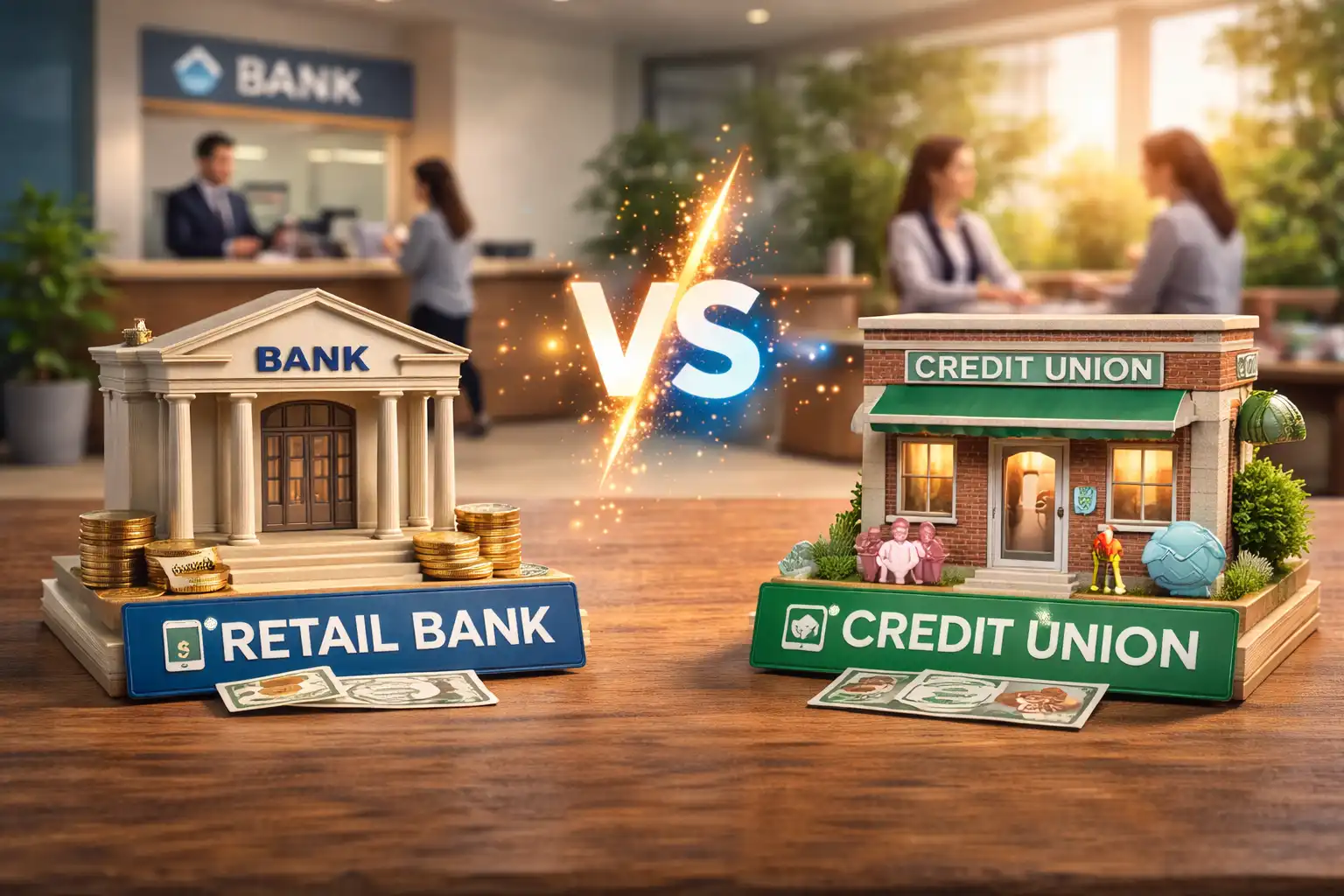
When I first started managing my money seriously, I kept asking myself one simple question: what is the major difference between retail banks and credit unions? As I dug deeper, I also found myself wondering what is a major difference between retail banks and credit unions? I wasn’t looking for marketing language or surface comparisons. I wanted to understand how the difference would actually impact my savings, loans, and long term financial security.
After researching major financial publications and comparing both systems personally, I realized the answer is simple: large national banks are for-profit institutions owned by shareholders, while credit unions are not-for-profit cooperatives owned by their members.
In this guide, I’ll break down ownership, profit structure, fees, rates, safety, technology, and which option may fit your financial priorities best.
That structural distinction influences rates, fees, service culture, and institutional priorities. Once I understood that, the entire comparison became clearer.Over time, I noticed how small structural differences translated into real differences in fees, loan approvals, and service interactions.
💡 Key Takeaways
- Ownership Drives Everything: Traditional banks are owned by shareholders seeking profits, while credit unions are member-owned cooperatives focused on serving their members.
- Rates and Fees Reflect Structure: Because credit unions reinvest earnings into member benefits, they often provide competitive loan rates and fewer service charges compared to many retail banks.
- Insurance Protection Is Comparable: Deposits at for-profit banks are insured by the FDIC and at credit unions by the NCUA, typically offering equal coverage limits for consumers.
- Experience and Access Differ: Retail banks usually provide larger branch networks and broader financial services, while credit unions often emphasize personalized, community-focused banking.
Are Both Retail Banks and Credit Unions Equally Safe?
Both are federally insured institutions in the United States. Large national banks are insured by the FDIC and credit unions are insured by the NCUA, typically up to $250,000 per depositor per account category. From a deposit protection standpoint, they are equally safe.
The Core Structural Difference Between Retail Banks and Credit Unions
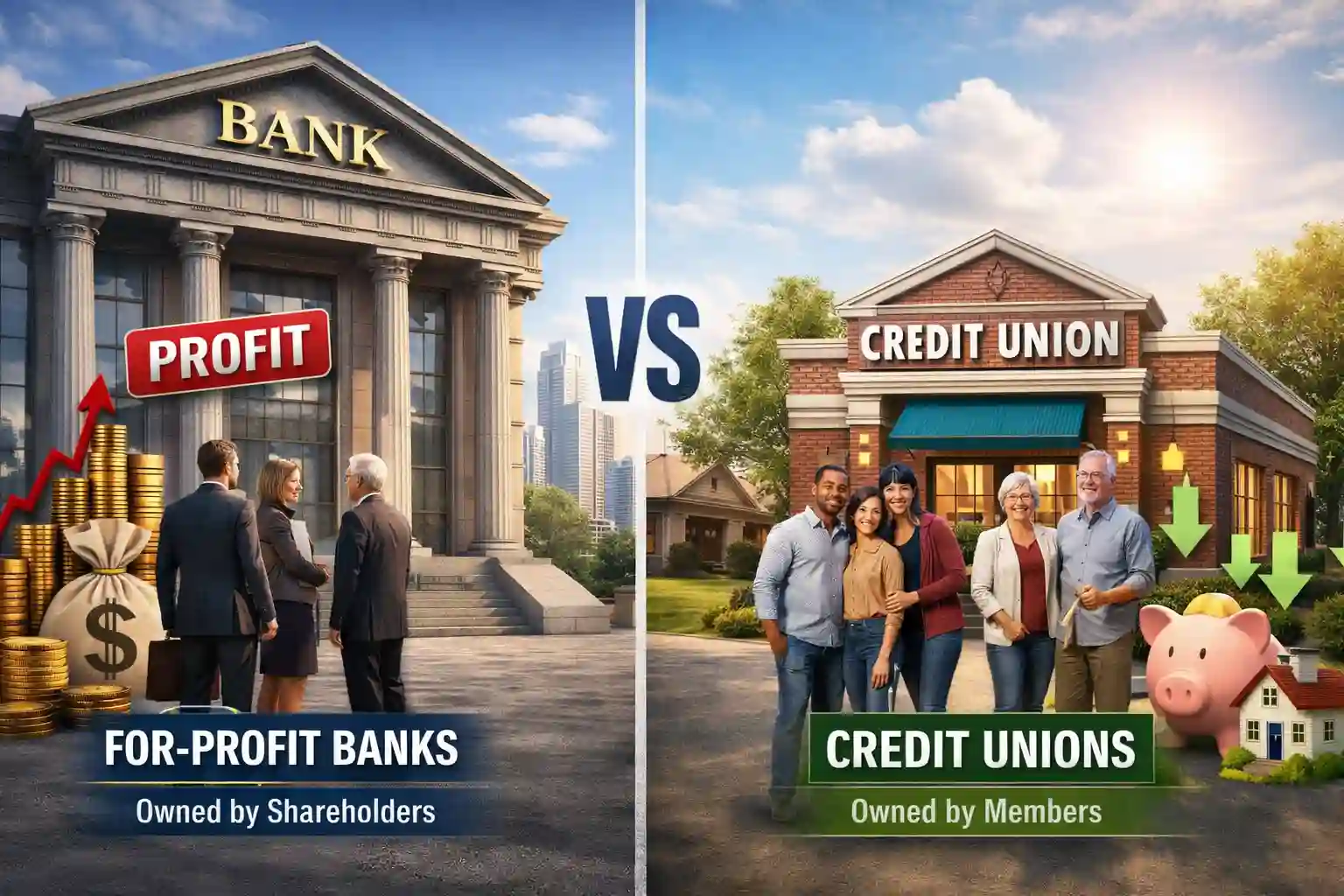
At the center of the debate is the difference between retail banks and credit unions ownership structure. For-profit banks are owned by shareholders who expect financial returns. Credit unions are owned by members who use their services, which changes how profits are distributed.
This ownership model determines the institution’s primary goal and financial incentives.
Bank Shareholder Model vs Member Owned Credit Unions
Traditional banks operate under a for-profit shareholder-driven business model. Their primary responsibility is generating profit for shareholders through growth and performance, much like the structural distinction seen in the difference between private equity and hedge funds where ownership and incentive alignment shape outcomes. That expectation shapes pricing, expansion, and strategy.
Credit unions follow a nonprofit credit union structure explained as a cooperative framework. Members are not just customers but partial owners with voting rights. Profits are typically returned to members through better rates and fewer fees.
How Profit Distribution Impacts Rates
When I compared loan offers, ownership stopped feeling theoretical and started feeling practical. Even a 0.50% difference in APR on a five-year auto loan can translate into hundreds of dollars in savings.
Why Credit Unions Offer Lower Loan Interest Rates
Many people ask why credit unions offer lower loan interest rates. Because they are not paying dividends to external investors, surplus earnings can be passed back to members. That often translates into competitive auto loan and mortgage APRs.
Retail Bank Savings Account Interest Comparison
A retail bank savings account interest comparison frequently shows lower base rates at traditional big banks. Online divisions may offer higher yields, but branch-based accounts often lag. When evaluating options, some investors even ask in which situation would a savings bond be the best investment to earn interest? as they compare fixed-income safety with bank-based savings returns. Credit unions tend to emphasize member returns rather than stock performance.
Fees: Where Structure Becomes Visible
Fees often reveal institutional priorities more clearly than marketing language.
Overdraft Fee Differences Banks and Credit Unions
When reviewing my statements, the overdraft fee differences between banks and credit unions were noticeable. Some large national banks layer fees quickly, increasing total penalties. Credit unions often structure overdraft policies more conservatively.
Monthly Maintenance Fee Comparison Retail Banks vs Credit Unions
The monthly maintenance fee comparison retail banks vs credit unions often favors credit unions. Many waive fees with basic account activity or small balance thresholds. Many traditional banks sometimes require higher balances to avoid charges.
Deposit Insurance and Safety
Safety was my biggest concern before making any decision.
Are Credit Union Deposits Federally Insured?
Yes, and this was reassuring. Credit unions are insured by the National Credit Union Administration. That protection mirrors what banks receive through federal insurance.
FDIC vs NCUA Insurance Coverage Limits Explained

Understanding FDIC vs NCUA insurance coverage limits explained cleared up confusion. Retail banks are insured by the FDIC, and credit unions are insured by the NCUA. Both typically protect deposits up to $250,000 per depositor per account category.
You can verify current coverage details directly through the official FDIC and NCUA websites.
Membership and Eligibility
Most traditional banks are generally open to anyone. Credit unions may require eligibility based on location, employer, or association.
Who Can Join a Credit Union Eligibility Rules
Who can join a credit union eligibility rules depend on the institution’s charter. Some are community-based, others employer-based. Many modern credit unions now offer surprisingly broad access.
Field of Membership Meaning in Credit Unions
The field of membership meaning in credit unions refers to the defined group eligible to join. It may be geographic or occupational. In practice, most people qualify for at least one credit union nearby.
Branch Networks and Technology
Technology Experience Comparison
Large national banks often invest heavily in mobile apps, budgeting tools, and digital innovation. Credit unions typically offer reliable platforms, but may not always lead in new feature rollouts. In some cases, smaller credit unions may also have fewer in-app budgeting tools or slower feature updates compared to major national banks. If tech convenience is your priority, this difference may matter.
Convenience is often the deciding factor for many consumers.
Branch Network Size Retail Banks vs Credit Unions
The branch network size retail banks vs credit unions comparison typically favors large national banks. They operate extensive domestic and international networks. That matters for frequent travelers or relocations.
Shared Branching System Credit Unions Explained
The shared branching system credit unions explained model offsets this disadvantage. Thousands of credit unions participate in cooperative networks like CO OP Shared Branch. In fact, the CO OP network gives credit union members access to more surcharge-free ATMs than some major national banks, which surprises many first-time researchers.
Customer Experience Differences
Service culture was one of the biggest emotional differences I noticed.

Personalized Service at Local Credit Unions
The personalized service at local credit unions often feels relationship-driven. Staff may know members by name and provide individualized guidance. The atmosphere can feel community-oriented.
Corporate Banking Experience Retail Banks Explained
The corporate banking experience retail banks explained is typically more standardized. Large banks rely on centralized systems and automated processes. Efficiency is strong, but personalization can feel limited.
Product Offerings and Scope
Traditional banks often provide broader financial ecosystems.
Investment Account Options at Retail Banks
Investment account options at retail banks commonly include brokerage accounts, retirement planning, and wealth management services. This can create a one-stop financial hub. Credit unions may partner externally for investment offerings.
Business Banking Services Credit Unions vs Banks
Comparing business banking services credit unions vs banks reveals scale differences.Larger for-profit banks often support advanced treasury management and international operations. Credit unions tend to focus on local small business relationships.
At a Glance Comparison Table
Below is a simplified breakdown that reflects what most users are actually evaluating:
| Feature | Retail Bank | Credit Union |
| Primary Goal | Maximize profit for shareholders | Serve financial needs of members |
| Ownership | Shareholders | Member-owners |
| Profit Distribution | Paid to investors or reinvested | Returned to members via better rates |
| Deposit Insurance | FDIC up to $250,000 | NCUA up to $250,000 |
| Membership | Open to public | Requires eligibility |
| Fees | Often higher and more numerous | Typically lower or fewer |
| Interest Rates | Lower on savings, higher on loans | Higher on savings, lower on loans |
| ATM Access | Large national networks | Shared branching and CO OP networks |
| Technology | Often cutting-edge apps | Solid but sometimes simpler |
| Service Style | More automated and scaled | More personalized and local |
Cost vs Convenience Decision Snapshot

If your goal is minimizing loan APR and avoiding recurring maintenance fees, credit unions often win. If your goal is nationwide mobility, advanced mobile banking tools, and integrated investment services, larger national banks may offer stronger infrastructure. Most users are ultimately deciding between cost efficiency and convenience scale.
What Users Are Really Deciding Between
After reading countless comparisons, I realized most people are not debating ideology. They are deciding between convenience and cost.
If you prioritize nationwide branch access, cutting-edge mobile apps, and seamless relocation flexibility, a retail bank may align better with your lifestyle. The typical credit union user prioritizes lower APRs, fewer maintenance fees, and community-focused service.
What Is a Major Difference Between Retail Banks and Credit Unions?
At its core, what is a major difference between retail banks and credit unions comes down to ownership and profit structure. Retail banks answer to shareholders, while credit unions answer to members.
That fundamental difference shapes every other comparison point.
FAQs
1. What is the main difference between retail banks and credit unions?
The main difference is ownership structure. Traditional banks are shareholder-owned corporations, while credit unions are member-owned cooperatives.
2. Why do credit unions usually offer better interest rates?
Because they are not distributing profits to investors, credit unions can redirect surplus earnings into better loan and savings rates.
3. Are deposits in credit unions insured like banks?
Yes. Retail banks are insured by the FDIC and credit unions are insured by the NCUA, typically up to $250,000.
4. Can anyone join a credit union?
Eligibility depends on the institution’s field of membership, but many credit unions now offer broad access criteria.
5. Which institution is better for small businesses, banks or credit unions?
Small businesses may benefit from relationship-based credit unions, while larger enterprises may prefer the broader infrastructure of major banks.
Final Thoughts
If you’re evaluating where to open your next account, compare the fee schedules and rate sheets carefully before deciding. After analyzing structure, profit distribution, fees, rates, technology, and service culture, the distinction becomes surprisingly simple. Retail banks are built to generate profit for investors, while credit unions are built to serve their members.
If you still find yourself asking what is a major difference between retail banks and credit unions, it ultimately comes down to ownership and purpose. Once you understand that difference, choosing between them becomes a strategic financial decision rather than a confusing comparison.