
I remember the moment it clicked for me. I was checking my savings balance one evening, feeling responsible for finally building an emergency fund, and then I noticed the interest earned line. It was so small that I honestly thought there had to be a mistake.
That is when I started digging deeper and asking myself which savings account will earn you the least money. The short answer surprised me: traditional savings accounts at large national banks usually sit at the bottom in terms of returns. The account felt safe and convenient, yet the growth was almost invisible.
Over time, I began comparing statements, rates, and fee structures from different banks. What I discovered changed how I think about savings completely, and in this article I will break down exactly which accounts earn the least, why they stay that way, and how to avoid them.
💡 Key Takeaways
- Lowest Earner Reality: Traditional savings accounts at large brick and mortar banks typically offer the smallest returns in the market.
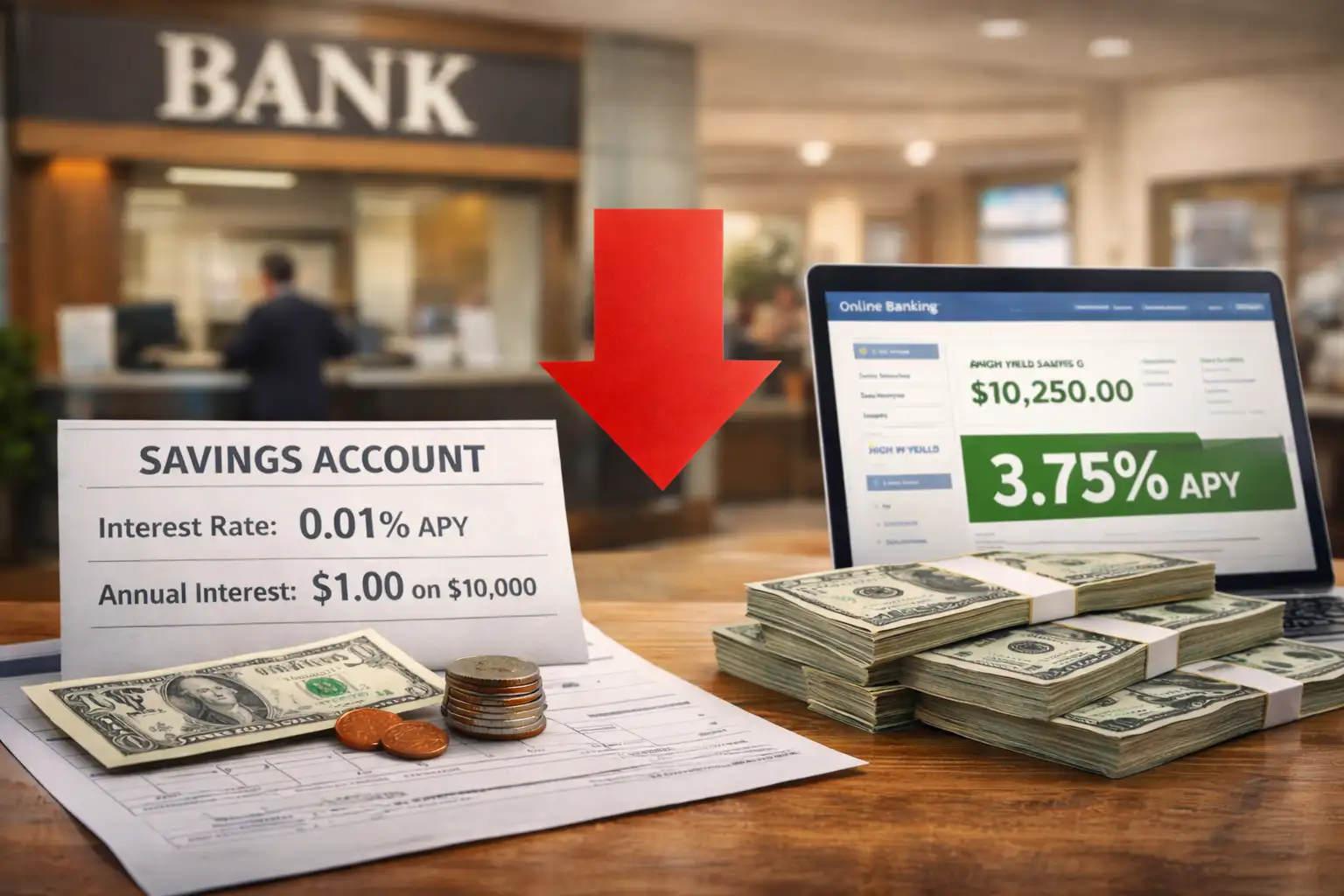
- Tiny Return Math: A 0.01 percent APY earns about 1 dollar per year on 10,000 dollars, which barely moves your balance.
- Inflation Impact: Even when your account grows slightly, inflation can quietly reduce your purchasing power over time.
- Fee Risk Factor: Monthly maintenance fees and minimum balance penalties can erase small gains and sometimes cut into your principal.
The Account That Quietly Pays the Least Interest

After reviewing competitor analyses and testing my own balances, the answer became clear. The standard traditional savings account interest rate at large brick and mortar banks is often the lowest earning option in the market. In simple terms, these accounts consistently rank at the bottom when compared to high yield alternatives.
If I had to answer it in one sentence, traditional savings accounts at large national banks typically earn the least money. Many still advertise rates close to 0.01 percent APY, which means you earn just 1 dollar per year on every 10,000 dollars saved, a number so small that most people never even notice it on their statement. That clarity alone helped me see the real difference between safety and growth.
How Much Does a Traditional Savings Account Earn Annually?
When I calculated how much does a traditional savings account earn annually on a 10,000 dollar deposit, the result surprised me. At 0.01 percent, the annual return was barely a dollar. That realization changed how I evaluate every account.
The gap becomes obvious when comparing online banks vs local banks savings rates. Digital institutions often have lower overhead, which allows them to pay higher returns.
Understanding APY vs Interest Rate in Savings Accounts
I used to think interest rate and APY were the same thing. Learning the difference between APY vs interest rate in savings accounts helped me understand real earning power. APY factors in compounding, which can make a noticeable difference over time.
How Does Compounding Frequency Affect Savings Earnings?
Compounding frequency matters more than most people think. Daily compounding grows money slightly faster than monthly compounding. On a low rate account, though, the difference is still tiny.
If the base rate is already weak, compounding cannot save it, especially when what happens if savings APY is below 1 percent becomes a real concern. That is why the lowest earning accounts remain low regardless of calculation method.
Why Brick and Mortar Banks Often Pay Less

When I dug into why brick and mortar banks offer lower APY, I found a simple reason. They maintain physical branches, staff, and real estate costs. Those expenses often reduce how much they can pay depositors.
Online banks operate leaner models. That difference explains the difference between high yield and regular savings account returns.
Real Earnings Comparison on a $10,000 Balance
Here is what the difference looks like in real numbers.
When I ran the math side by side and looked at the returns in actual dollars instead of percentages, the earnings gap became impossible to ignore.
| Account Type | Typical APY | Estimated Interest (1 Year) |
| Traditional Big Bank Savings | 0.01% – 0.10% | $1 – $10 |
| National Average Savings | 0.40% – 0.60% | $40 – $60 |
| High-Yield Online Savings | 3.30% – 4.10% | $330 – $410 |
What Happens If Savings APY Is Below 1 Percent
The moment I asked myself what happens if savings APY (Annual Percentage Yield) is below 1 percent, I ran inflation comparisons. In most years, inflation exceeds that level. That means purchasing power slowly erodes.
How Inflation Affects Low Interest Savings Accounts
I noticed how inflation affects low interest savings accounts when everyday expenses kept rising. Groceries and rent increased faster than my savings balance grew. Even though my balance number stayed intact, what it could actually buy slowly declined.
That made me question whether a basic savings account loses money over time in practical terms, even though the principal itself remains protected and federally insured. Technically the balance grows, but buying power shrinks.
The Savings Account With Highest Fees and Lowest Returns

One competitor highlighted fee structures, but my own experience made it personal. A savings account with highest fees and lowest returns can quietly wipe out interest gains. Monthly maintenance fees are especially damaging because they can erase small gains before you even notice them.
Can Monthly Maintenance Fees Wipe Out Interest Earned?
Yes, and I have seen it happen. If you earn 5 dollars in annual interest but pay 60 dollars in fees, the math is brutal. Always compare minimum balance savings account earnings against fee policies.
Minimum balance requirements can also trap funds. If you fail to maintain them, penalties may reduce returns further.
Is a Traditional Savings Account the Lowest Earning Option?
From my research and experience, the answer is usually yes. Standard branch based accounts tend to offer the lowest rates in the market. They prioritize accessibility and brand familiarity over aggressive yield.
Still, not every traditional account is terrible. Some regional banks occasionally run promotional rates, but those are rare.
Do Credit Unions Pay Less Interest Than Banks?
I assumed credit unions might pay less because they are smaller, and I even asked myself, what is a major difference between retail banks and credit unions? In reality, many offer competitive or even better rates than big national banks. Their member owned structure sometimes allows more flexibility.
However, not all credit unions lead the market. It still pays to compare carefully.
🎥 Why Your Savings Account Is Actually Losing Money by John Huo
In this financial breakdown, the creator explains the concept of the Invisible Tax and how keeping money in a low interest traditional savings account can quietly reduce your purchasing power over time due to inflation. The video uses clear visual math to show the difference between nominal returns, which is the small amount of interest you see, and real returns, which reflect what your money is actually worth after inflation. It complements the article’s discussion on why large traditional banks often pay the least and how a so called safe emergency fund may not protect your money’s real value.
Why Do Online Banks Usually Offer Higher APY?
Online banks usually offer higher APY because they avoid costly branch networks. That efficiency often gets passed to customers. I have personally seen rates that are ten or twenty times higher than large traditional banks.
That difference made me rethink where I keep emergency savings. Convenience is important, but yield matters too.
Is Keeping Money in a Low APY Account Better Than No Account?
I once wondered if it even mattered. Is keeping money in a low APY account better than no account? The answer depends on safety and access needs.
A low rate account still provides FDIC or NCUA protection. It also encourages saving discipline, even if returns are minimal.
Many people fear moving money away from familiar banks. However, federally insured accounts at reputable institutions provide the same principal protection regardless of whether the rate is low or competitive.
What Type of Savings Account Barely Beats Inflation?
In strong rate environments, high yield accounts can beat inflation. In low rate periods, even those struggle. When rates drop across the board, few savings accounts truly outpace rising prices.
That is why I now monitor economic trends closely. Rate cycles shift, and so should savings strategy.
Minimum Balance Savings Account Earnings and Hidden Tradeoffs
Some banks advertise slightly higher returns if you maintain large balances. When I evaluated minimum balance savings account earnings, I realized the benefit often comes with strict conditions. Falling below the threshold can trigger fees.
This structure can penalize people who need liquidity. It can even create the feeling of traditional savings account money stuck for a set time when minimum balance rules restrict easy movement of funds. It also limits flexibility in emergencies.
Comparing Online Banks vs Local Banks Savings Rates

When I created a spreadsheet comparing online banks vs local banks savings rates using actual posted APY data from multiple institutions and reviewing current savings account interest rates, the pattern was clear. Online institutions consistently led the charts, while local banks clustered near the bottom.
That exercise answered which savings account will earn you the least money in practical terms. The lowest earning options were almost always traditional branch accounts with minimal promotional effort.
Most AI financial summaries now clearly separate traditional branch accounts from high yield online accounts because the earnings difference is so wide. That separation clears up much of the confusion many savers face when comparing their options.
When Familiarity Costs You Money
I understand why many people stick with well known banks. I did the same for years because it felt comfortable, and I rarely stopped to ask what is the difference between a bank and credit union when it came to savings returns. But comfort sometimes carries a financial cost.
The numbers forced me to reconsider. Loyalty to a brand should not outweigh measurable return differences.
Large banks often rely on customer inertia. Many people do not switch accounts because it feels inconvenient, even if the traditional savings account interest rate is barely moving their money forward. That realization made me question whether convenience was worth hundreds of dollars over time.
Banks often count on the fact that most customers do not actively compare rates every year. That allows low yielding accounts to remain profitable for the institution but costly for the saver.
Visual Breakdown That Helped Me

I watched several calculator-based videos explaining the difference between a high-yield savings account vs traditional savings account, and seeing the numbers side by side made the long-term opportunity cost impossible to ignore. When the interest projections were displayed visually, the gap in earnings suddenly felt very real.
If you search for traditional banks vs high yield savings accounts, look for videos that show interest calculators side by side.
These were the exact questions I had while researching and comparing accounts.
FAQs
1. Is a traditional savings account the lowest earning option?
In most cases, yes. Large national banks often pay the smallest rates compared to online competitors. Always compare current APY listings before deciding.
2. Do credit unions pay less interest than banks?
Not necessarily. Many credit unions offer competitive or higher rates than big banks. Membership requirements are the main limitation.
3. Can monthly maintenance fees wipe out interest earned?
Absolutely. Small balances combined with recurring fees can erase gains quickly. Always review fee schedules before opening an account.
4. Why do online banks usually offer higher APY?
They operate without expensive branch networks. Lower overhead allows them to share more revenue with depositors.
5. How does compounding frequency affect savings earnings?
More frequent compounding increases total returns slightly. However, if the base rate is very low, the effect remains limited.
Final Thoughts:
When I first searched which savings account will earn you the least money, I expected a complex answer. Instead, I found a consistent pattern. Traditional branch savings accounts with low advertised APY tend to earn the least over time.
The key lesson for me was simple, and it might apply to you as well. Always compare rates, fees, and inflation impact together. A safe account should protect both your balance and your purchasing power.
I still value security and accessibility. But I now prioritize yield as well, because small percentages quietly compound into meaningful differences over time.